
How to Maximise CPF In Your 20s at Singapore
SINGAPORE BLOGSINGAPORE FINANCE NEWS
7/12/20264 min read
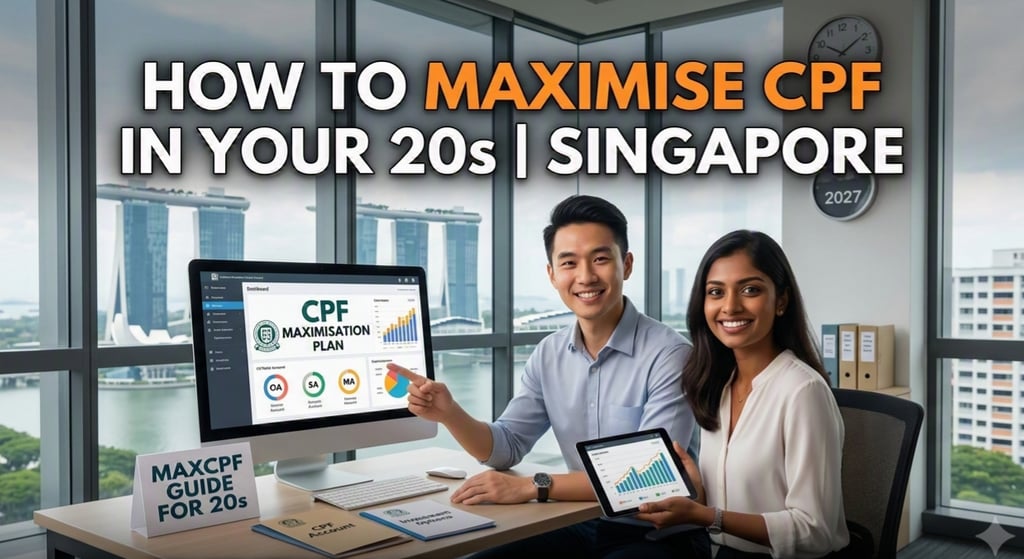
As a young adult in Singapore, you might not think much about your Central Provident Fund (CPF) until it’s time to retire. However, understanding how to maximize your CPF contributions in your 20s can significantly impact your financial future. In this blog post, we will explore the various strategies for CPF transfers, top-ups, and tax relief that can help you build a robust retirement fund.
Understanding CPF Accounts
The CPF system is not just a single account; it consists of multiple accounts, each with different interest rates. Here’s a breakdown:
Ordinary Account (OA): Offers a base interest rate of 2.5% per annum.
Special Account (SA): Provides a higher interest rate of at least 4% per annum.
Medisave Account: Used for medical expenses and has a different interest rate structure.
Understanding these accounts is crucial for making informed decisions about your CPF contributions.
The Importance of Transfers
One of the first strategies to consider is transferring funds from your Ordinary Account to your Special Account. This can be beneficial because:
The Special Account earns a higher interest rate.
It helps you accumulate more savings for retirement.
It can provide a buffer for your long-term financial goals.
For instance, if you are 26 years old and you transfer funds to your Special Account, you could see a significant increase in your retirement savings by the time you reach 55.
Voluntary Top-Ups: A Game Changer
Another effective strategy is making voluntary top-ups to your Special Account. Here’s how it works:
Without any top-ups, a 26-year-old might have around $185,000 in their Special Account by the age of 55. However, if you contribute an additional $5,000 each year, that amount could skyrocket to $481,000. That’s nearly $300,000 more!
Timing is also crucial when it comes to top-ups. Since interest is accrued monthly but paid annually, making your top-up earlier in the year allows your money to grow for a longer period.
How Much Should You Top Up?
The amount you should top up depends on your individual financial situation. Here are some factors to consider:
Your monthly cash flow needs.
Your income streams.
Your long-term financial goals.
Every bit counts, so even small contributions can make a significant difference over time.
Trade-Offs of Topping Up
While topping up your CPF can be beneficial, it does come with trade-offs. Every dollar you contribute is a dollar you cannot use today. This is particularly important if you are saving for significant expenses, such as purchasing an HDB flat. You need to balance your immediate financial needs with your long-term savings goals.
Tax Relief Opportunities
Topping up your CPF can also help you reduce your taxable income. Here’s how:
You can receive up to $8,000 in tax relief per year for contributions made to your own CPF.
Additionally, you can claim another $8,000 for contributions made on behalf of your spouse or close relatives.
However, it’s important to note that the benefits of these reliefs are more pronounced at higher income levels. For fresh graduates, the savings might be minimal, so it’s essential to plan accordingly.
Supplementary Retirement Scheme (SRS)
Another tool for tax relief is the Supplementary Retirement Scheme (SRS). You might wonder if it’s too early to set up an SRS account. Here are some considerations:
The SRS account offers a low interest rate of 0.05% on balances.
To maximize your SRS contributions, consider investment opportunities that can yield higher returns.
Your income level will determine how much tax relief you can enjoy from SRS contributions.
Investing your SRS funds wisely can help you achieve better returns than the nominal interest rate offered by the account.
Should You Aim for the Full Retirement Sum?
Deciding whether to top up to the full retirement sum is a personal choice. Here are some pros and cons:
Pros: Achieving the full retirement sum can provide peace of mind regarding your retirement adequacy.
Cons: It may limit your liquidity, as the funds will be locked until you reach retirement age.
Consider your ongoing expenses and financial needs before making this decision.
Investing Your CPF: A Viable Option?
Another question that often arises is whether to invest your CPF funds or let them compound. Here are some key considerations:
Your knowledge of investing and ability to generate returns above CPF interest rates.
Your risk appetite and comfort with market volatility.
Your time horizon until retirement.
For younger individuals, the longer time horizon allows for more aggressive investment strategies, while those closer to retirement may prefer the stability of CPF accounts.
Conclusion: Taking Action
After exploring these options, it’s clear that CPF is not just a distant concern; it’s a vital part of your financial planning. By making informed decisions about transfers, top-ups, and tax relief, you can significantly enhance your retirement savings.
As you move forward, consider setting aside funds for your Special Account and mark your calendar for annual top-ups. Remember, every little bit helps in building a secure financial future.
To read about money - https://powerwithmoney.com/
To read about Singapore Finance News : https://powerwithmoney.com/singapore-finance-news
To read business book summaries - https://powerwithmoney.com/business-book-summaries
To read primary school compositions: https://sgessays.com/singapore-primary-school-compositions
To read secondary school essays: https://sgessays.com/singapore-secondary-school-essays
To read general papers essays: https://sgessays.com/general-paper-essays
To read tips on improving compositions/essays :https://sgessays.com/tips-to-improve-esssays-compositions
To read sample of letters,emails and reports (Situational Writing) - https://sgessays.com/situational-writing
To visit our main website : https://sgessays.com/
PSLE themed compositions - https://sgessays.com/100-theme-based-compositions
PSLE Continuous writing Compositions - https://sgessays.com/continuous-writing-compositions-examples
PSLE Situational writing - https://sgessays.com/situational-writing-compositions-examples
PSLE Listening comprehension - https://sgessays.com/primary-6-psle-listening-comprehension
PSLE Oral examination - https://sgessays.com/psle-english-oral-examinations
Secondary School Narrative essays - https://sgessays.com/narrative-essays
Secondary School Exposition essays https://sgessays.com/expository-essays
Secondary School Argumentative essays- https://sgessays.com/argumentative-essays
Secondary School Reflective essays - https://sgessays.com/reflective-essays
Secondary School Descriptive Essays https://sgessays.com/descriptive-essays
Junior College General Papers - https://sgessays.com/general-paper-essays
To read thrilling and bone chilling ghost stories visit : https://asiaghosts.com/
To read ghost stories related to houses/HDB: https://asiaghosts.com/house/
To read ghost stories related to school: https://asiaghosts.com/schools/
To read stories related to strange incidents : https://asiaghosts.com/strange-incidents/
To download free exam papers - https://singaporeexampapers.com/
To download free kids movies - https://www.singaporeexampapers.com/kids-movies
To download summary notes for english,math and science subjects - https://www.singaporeexampapers.com/subject-based-summary-notes
To download worksheets and resources for relief classes - https://www.singaporeexampapers.com/relief-teacher-worksheets-and-resources
To download topic based papers - https://www.singaporeexampapers.com/topic-based-practice-papers
To download subject based crossword puzzles - https://www.singaporeexampapers.com/subject-based-crossword-puzzles
To read tips and advice for Singapore exams - https://www.singaporeexampapers.com/tips-and-advice
To practice various subjects quizzes - https://www.singaporeexampapers.com/quizzes