
The Dip by Seth Godin - A Summary
Seth Godin shows how to tell the difference between a temporary setback worth pushing through and a dead end that deserves a strategic exit.
BUSINESS BOOK SUMMARIES
7/1/20267 min read
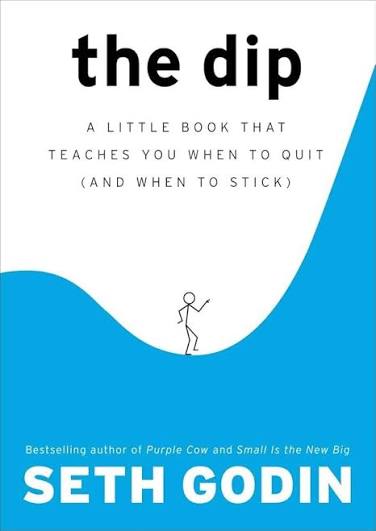
THE DIP
Author: Seth Godin
The Big Idea in 30 Seconds
Seth Godin is a bestselling author, entrepreneur, and marketing thinker known for writing about leadership, change, creativity, and meaningful work.
In The Dip, the central idea is that successful people don’t simply refuse to quit. They quit the wrong things early so they can commit more time, energy, and money to the few challenges worth pushing through.
The book explains how to tell the difference between a temporary struggle that leads somewhere valuable and a dead end that will never reward continued effort. Smart persistence means staying committed to the right path, not treating every unfinished project as a duty.
The Insight in Plain English
Almost every worthwhile goal becomes harder after the excitement wears off.
The early stage may feel interesting because progress comes quickly. Then improvement slows, obstacles appear, and the work becomes repetitive or uncomfortable. Godin calls this difficult middle period the Dip.
A Dip can be valuable because it separates people who are merely interested from those willing to develop rare skills. But some struggles aren’t Dips. They’re dead ends. The practical skill is knowing whether more effort will create a better future or simply consume resources that should be used elsewhere.
If this idea resonated with you, share it with your network using the social sharing buttons at the top of this post.
Core Concepts / Frameworks / Examples
The Dip is a temporary struggle with a valuable outcome.
A Dip appears between starting something and becoming genuinely good at it. Learning a difficult skill, building a trusted brand, entering a demanding market, or developing a strong team may require a long period when effort rises faster than results. The Dip is worth crossing when success on the other side would create a meaningful advantage.
A Cul-de-Sac is a dead end.
A Cul-de-Sac is a situation where continued effort produces little meaningful improvement. The work may stay difficult without moving toward a stronger position. A product with no demand, a partnership that never becomes productive, or a process that can’t scale may be a dead end rather than a temporary setback.
Strategic quitting protects limited resources.
Time, money, attention, and talent are limited. Continuing every project means fewer resources are available for the work with the greatest potential. Quitting becomes strategic when it frees the organization to focus on a more valuable opportunity.
Being the best in a useful category creates an advantage.
Customers often choose the option they consider best for their needs, whether that means the most trusted specialist, the fastest provider, or the easiest product to use. A business doesn’t need to dominate an entire industry. It needs to become the strongest choice within a category that matters to a defined group of customers.
Decide when to quit before pressure takes over.
People make poor quitting decisions when they’re tired, embarrassed, angry, or afraid. Set expectations before entering the Dip. Define how much time, money, and effort the opportunity deserves, what evidence would support continuing, and what conditions would trigger an exit.
How to Apply This to Your Business
Start by listing the major projects, products, markets, partnerships, and initiatives currently consuming resources. Include work that continues through habit even if nobody can explain its current value.
For each item, define the desired outcome. Be precise. “Grow the business” is too broad. A stronger outcome might be reaching a certain number of profitable customers, achieving a target margin, reducing delivery time, or proving demand in a new market.
Identify what success would make possible. Crossing a difficult period is worthwhile only when the result creates real value. The reward might be stronger pricing, customer loyalty, lower costs, specialized expertise, recurring revenue, or a defensible market position.
Next, determine whether the current difficulty is a Dip or a dead end. Look for evidence of learning, improving conversion rates, stronger customer responses, better quality, or lower delivery costs. Slow progress can be acceptable when the underlying signals are getting better.
Watch for projects where the same problems repeat without learning. If the team has tried several reasonable changes and the evidence remains weak, more effort may not solve the issue. Persistence without improvement can become an expensive form of avoidance.
Set continuation rules before the next stressful moment. Decide how long the project will run, how much money it may use, which milestones it must reach, and when the team will review it. Written rules reduce the chance that pride or panic will control the decision.
Choose a small number of priorities. A company can’t cross every Dip at once. Identify which opportunities deserve concentrated effort and which activities should receive maintenance, delay, or cancellation.
Move strong people toward the most important challenge. Companies often spread their best employees across too many projects. Concentrating talent may create faster progress than adding more people to every initiative.
Create a stop-doing list. Include meetings, reports, product features, services, and approval steps that consume resources without improving customer value or business performance. Ending weak work is one of the fastest ways to create capacity.
Review your product portfolio. Some products may generate revenue but require so much support, customization, or complexity that they weaken the company. Measure profit, strategic value, customer demand, and operational burden rather than looking only at sales.
Examine customer segments. Not every customer is equally valuable or equally suited to the business.
Serving everyone can prevent the company from becoming exceptional for anyone. Define which customers the company can serve better than competitors can.
Choose a category where becoming the best is realistic and worthwhile. That category could be narrow. A company might become the most trusted provider for one industry, the easiest option for small teams, or the fastest service in one region.
Clarify what “best” means to the customer. Leaders may care about features customers barely notice. Talk to buyers and study their behavior. The deciding factor may be speed, trust, convenience, expertise, reliability, or lower risk.
Invest deeply in the capability that supports that position. If customers value speed, improve systems and handoffs. If they value expertise, strengthen hiring and training. If they value reliability, improve quality control and communication.
Don’t quit because the work becomes boring. Repetition often appears before mastery. The team may need to keep making sales calls, improving the product, practicing a process, or earning trust long after the initial excitement disappears.
Don’t continue simply because the company has already invested heavily. Past spending can’t be recovered by spending more. Evaluate the opportunity based on its future value, not the amount already committed.
Separate an uncomfortable task from a bad strategy. A salesperson may want to abandon outreach because rejection feels unpleasant. That doesn’t prove the market is wrong. Examine the data before deciding whether the obstacle is emotional resistance or weak demand.
Ask what would need to be true for the project to succeed. This exposes assumptions. A new service may require higher prices, faster delivery, better targeting, or a lower customer acquisition cost. Test the most uncertain assumption first.
Build review points into large projects. Don’t wait until the full budget has been spent. Pause at meaningful stages and compare actual results with the conditions set at the beginning.
Give project owners permission to recommend an exit. Employees may hide weak results when they believe quitting will damage their careers. Reward honest judgment when someone identifies that resources would create more value elsewhere.
Create a clear process for closing projects. Decide how customers, employees, partners, contracts, data, and unfinished commitments will be handled. Strategic quitting should reduce waste without creating unnecessary damage.
Communicate why something is ending. Explain what the company learned, why the opportunity no longer deserves investment, and where resources will go next. This helps employees see quitting as a business decision rather than a failure of confidence.
Avoid quitting only to escape short-term discomfort. A difficult quarter, one lost customer, or a failed experiment may not justify abandoning a sound strategy. Compare the setback with the original plan and longer-term evidence.
At the same time, don’t use resilience as an excuse to ignore reality. Leaders sometimes praise persistence because admitting a mistake feels painful. Real discipline includes ending work that no longer deserves support.
Review priorities regularly. A project that was worth pursuing last year may become less valuable after changes in technology, competition, customer behavior, or company strategy.
Finally, remember that quitting and commitment work together. The more quickly you remove weak priorities, the more fully you can support the work that matters. The goal isn’t to quit more often. It’s to stop wasting resources so the company can persist where persistence creates an advantage.
To read about money - https://powerwithmoney.com/
To read business book summaries - https://powerwithmoney.com/business-book-summaries
To read primary school compositions: https://sgessays.com/singapore-primary-school-compositions
To read secondary school essays: https://sgessays.com/singapore-secondary-school-essays
To read general papers essays: https://sgessays.com/general-paper-essays
To read tips on improving compositions/essays :https://sgessays.com/tips-to-improve-esssays-compositions
To read sample of letters,emails and reports (Situational Writing) - https://sgessays.com/situational-writing
To visit our main website : https://sgessays.com/
PSLE themed compositions - https://sgessays.com/100-theme-based-compositions
PSLE Continuous writing Compositions - https://sgessays.com/continuous-writing-compositions-examples
PSLE Situational writing - https://sgessays.com/situational-writing-compositions-examples
PSLE Listening comprehension - https://sgessays.com/primary-6-psle-listening-comprehension
PSLE Oral examination - https://sgessays.com/psle-english-oral-examinations
Secondary School Narrative essays - https://sgessays.com/narrative-essays
Secondary School Exposition essays https://sgessays.com/expository-essays
Secondary School Argumentative essays- https://sgessays.com/argumentative-essays
Secondary School Reflective essays - https://sgessays.com/reflective-essays
Secondary School Descriptive Essays https://sgessays.com/descriptive-essays
Junior College General Papers - https://sgessays.com/general-paper-essays
To read thrilling and bone chilling ghost stories visit : https://asiaghosts.com/
To read ghost stories related to houses/HDB: https://asiaghosts.com/house/
To read ghost stories related to school: https://asiaghosts.com/schools/
To read stories related to strange incidents : https://asiaghosts.com/strange-incidents/
To download free exam papers - https://singaporeexampapers.com/
To download free kids movies - https://www.singaporeexampapers.com/kids-movies
To download summary notes for english,math and science subjects - https://www.singaporeexampapers.com/subject-based-summary-notes
To download worksheets and resources for relief classes - https://www.singaporeexampapers.com/relief-teacher-worksheets-and-resources
To download topic based papers - https://www.singaporeexampapers.com/topic-based-practice-papers
To download subject based crossword puzzles - https://www.singaporeexampapers.com/subject-based-crossword-puzzles
To read tips and advice for Singapore exams - https://www.singaporeexampapers.com/tips-and-advice
To practice various subjects quizzes - https://www.singaporeexampapers.com/quizzes