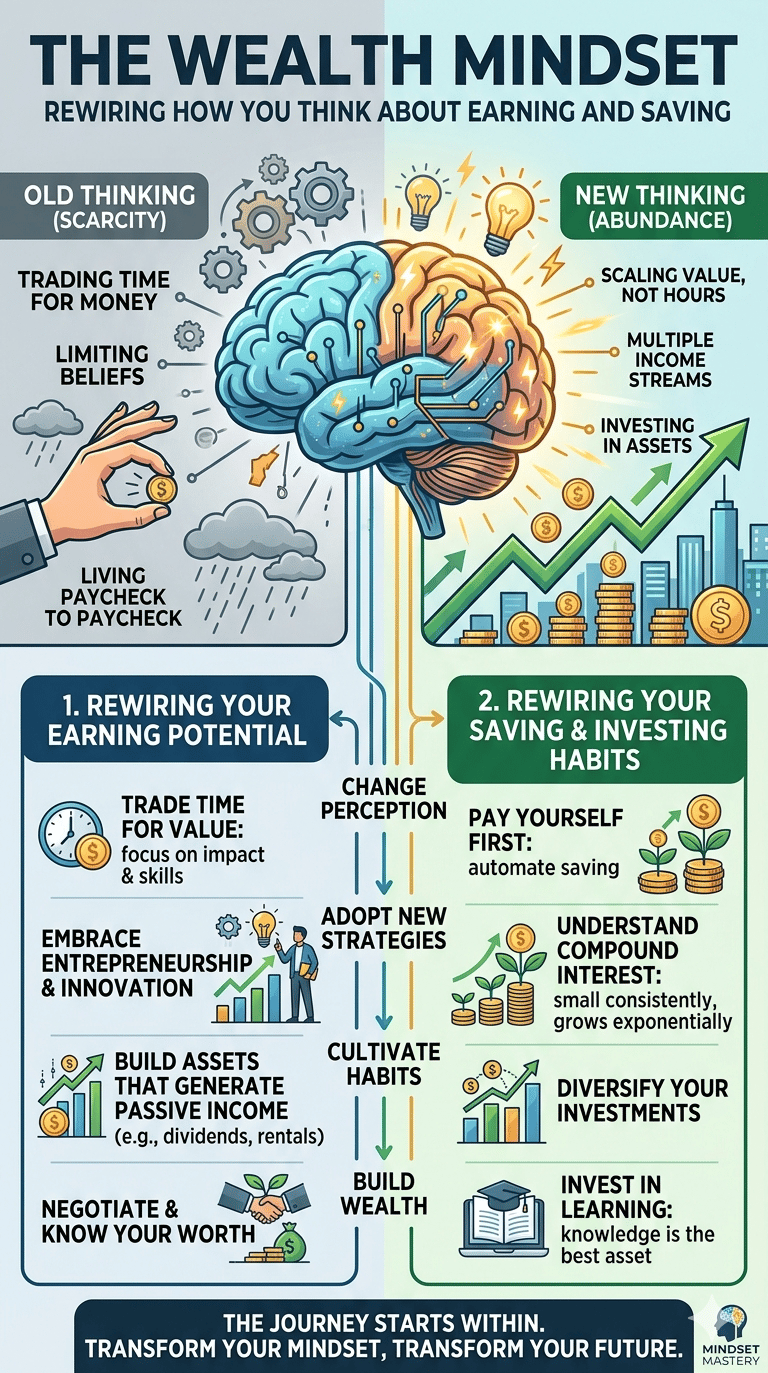
The Wealth Mindset: Rewiring How You Think About Earning and Saving
MONEYTIPS
6/3/20264 min read
The Wealth Mindset: Rewiring How You Think About Earning and Saving
Most people believe wealth is mainly about numbers.
A bigger salary.
A larger bank account.
More investments.
More assets.
But long before wealth shows up in your finances, it usually begins in your mindset.
The way you think about money influences nearly every financial decision you make:
How you earn
How you spend
How you save
How you invest
How you react to opportunities
How you handle setbacks
In many cases, financial growth is less about luck and more about learning a different way to think.
That’s what separates a scarcity mindset from a wealth mindset.
And developing that mindset can completely change your financial future.
What Is a Wealth Mindset?
A wealth mindset is the belief that money is a tool for growth, freedom, and opportunity — not just survival.
People with a wealth mindset tend to:
Think long-term
Focus on creating value
Prioritize learning
Seek opportunities instead of limitations
Build systems instead of relying only on effort
Understand delayed gratification
Make intentional financial decisions
This doesn’t mean they are born wealthy.
In fact, many financially successful people started with very little.
The difference is often psychological before it becomes financial.
Scarcity vs. Wealth Thinking
Scarcity thinking focuses on lack.
Examples include:
“There’s never enough money.”
“Rich people are just lucky.”
“I’ll never get ahead.”
“I need instant results.”
“Saving doesn’t matter because I don’t earn enough.”
Wealth thinking sounds different:
“How can I increase my income?”
“What skills are valuable?”
“How can money work for me?”
“What habits compound over time?”
“What opportunities am I missing?”
The mindset shift may seem subtle, but over years, it creates dramatically different outcomes.
Wealthy People Think Beyond Hourly Income
Many people are trained to think only in terms of trading time for money.
Work hours.
Get paid.
Repeat.
But wealth-focused thinking expands beyond active labor.
It asks:
Can this income scale?
Can this system become automated?
Can this investment grow?
Can this skill create future opportunities?
This is why financially successful people often prioritize:
Investments
Businesses
Digital products
Assets
Multiple income streams
They focus on leverage — ways to increase results without proportionally increasing effort.
Saving Is Not Punishment — It’s Power
One of the biggest mindset shifts around money involves saving.
Many people view saving as restriction:
Less fun
Less freedom
Less enjoyment
But financially disciplined people often see saving differently.
Saving creates:
Security
Flexibility
Opportunity
Reduced stress
Freedom to make better decisions
Without savings, every financial setback becomes a crisis.
With savings, you gain options.
And options are one of the most valuable forms of wealth.
Delayed Gratification Is a Superpower
Modern culture encourages instant rewards:
Buy now
Upgrade now
Consume now
Finance now
But wealth is often built through delayed gratification.
That means:
Investing instead of overspending
Building skills before chasing status
Creating assets before buying luxuries
Thinking years ahead instead of days ahead
Small disciplined decisions repeated consistently create enormous long-term results.
A wealth mindset understands that temporary restraint can produce permanent advantages.
Income Matters — But Habits Matter More
A high income alone does not guarantee wealth.
Many high earners still live paycheck to paycheck because spending rises with earnings.
This is called lifestyle inflation.
A wealth mindset avoids automatically increasing expenses every time income increases.
Instead, financially intelligent people often:
Increase investments first
Build emergency funds
Pay down debt strategically
Create new income streams
Preserve flexibility
Wealth is not only about what you earn.
It’s also about what you keep and grow.
Financial Education Changes Everything
Schools often teach people how to work for money.
Very few teach:
Investing
Taxes
Budgeting
Compound growth
Business systems
Financial psychology
As a result, many adults learn about money through stress, mistakes, or survival.
A wealth mindset prioritizes financial education continuously.
That doesn’t require expensive courses.
Today, valuable financial knowledge is widely accessible through:
Books
Podcasts
Online content
Newsletters
Investing platforms
Free educational resources
The more you understand money, the less intimidating it becomes.
Wealthy Thinking Focuses on Ownership
Consumers spend.
Owners build.
That’s one of the biggest differences in financial thinking.
Ownership can include:
Stocks
Businesses
Intellectual property
Digital products
Real estate
Valuable skills
Content platforms
Ownership creates long-term leverage.
Even small forms of ownership can eventually generate income, equity, and opportunity.
Comparison Is Financially Dangerous
One of the fastest ways to damage your financial mindset is constant comparison.
Social media often creates pressure to:
Spend more
Look successful
Upgrade lifestyles prematurely
Chase appearances over stability
But many outward signs of wealth are financed through debt and financial stress.
A wealth mindset focuses less on appearing rich and more on becoming financially secure.
Real wealth is often quiet.
How to Start Rewiring Your Financial Thinking
Changing your money mindset does not happen overnight.
But small shifts matter.
1. Track Your Spending
Awareness creates control.
2. Learn One Financial Skill at a Time
Investing, budgeting, side income, or debt management.
3. Focus on Increasing Value
Higher-value skills often lead to higher-income opportunities.
4. Think Long-Term
Short-term emotions often create poor financial decisions.
5. Build Before Consuming
Create assets before chasing luxuries.
6. Surround Yourself with Better Financial Ideas
Books, conversations, and environments influence thinking more than most people realize.
The Real Meaning of Wealth
True wealth is not only about luxury.
It’s about:
Having choices
Reducing stress
Creating stability
Gaining freedom over your time
Living without constant financial fear
Money alone cannot solve every problem.
But financial insecurity creates many unnecessary ones.
A wealth mindset helps you move from reacting to money emotionally toward using it intentionally.
And that shift — the way you think, save, earn, and plan — can become the foundation for an entirely different future.
Because wealth is rarely built in a single moment.
It is usually built through repeated patterns of thinking and behavior over time.
To read thrilling and bone chilling ghost stories visit : https://asiaghosts.com/
To read ghost stories related to houses/HDB: https://asiaghosts.com/house/
To read ghost stories related to school: https://asiaghosts.com/schools/
To read stories related to strange incidents : https://asiaghosts.com/strange-incidents/
To read latest stories around the world : https://sgfollowsall.com/
To read latest viral Singapore stories around the world : https://sgfollowsall.com/singapore-news/
To read latest viral Asia stories around the world : https://sgfollowsall.com/asia-news/
To read primary school compositions: https://sgessays.com/singapore-primary-school-compositions
To read secondary school essays: https://sgessays.com/singapore-secondary-school-essays
To read general papers essays: https://sgessays.com/general-paper-essays
To read tips on improving compositions/essays : https://sgessays.com/tips-to-improve-esssays-compositions
To read sample of letters,emails and reports (Situational Writing) – https://sgessays.com/situational-writing-letters-emails-and-reports
To read tips on oral examinations: https://sgessays.com/psle-english-oral-examinations
To practice listening comprehensions : https://sgessays.com/listening-comprehension
To read on interesting Singapore Teacher’s stories / Forum : https://sgessays.com/singapore-teachers-storiesforum
To read free compositions and essays: https://sgessays.com/
To read about how to make money : https://powerwithmoney.com