Breakthrough Advertising

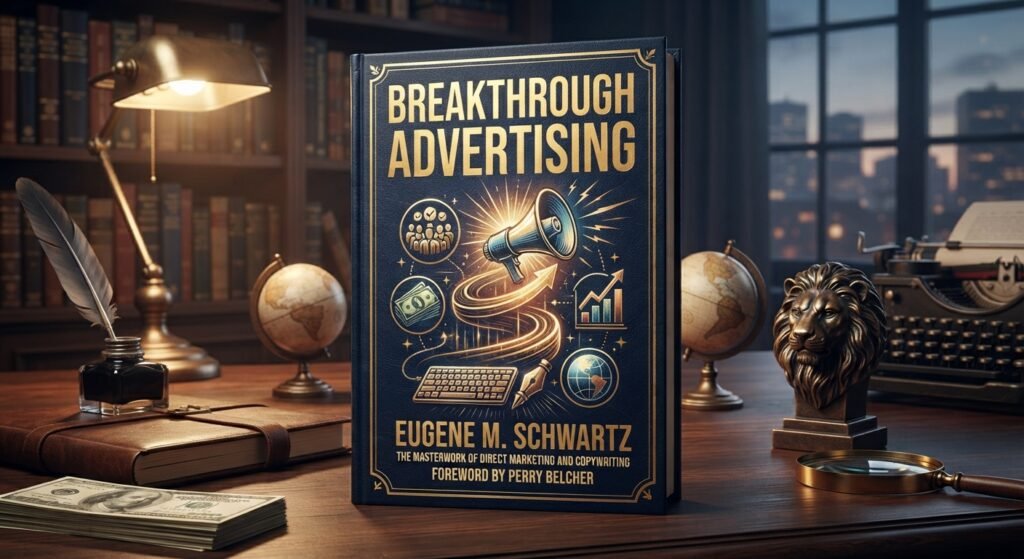
1. The central idea of the book
The main message of Breakthrough Advertising is that successful advertising does not create desire. Instead, it identifies desires that already exist in the market and directs those desires towards a particular product or service.
People already want things such as:
- More money and financial freedom.
- Better health and physical appearance.
- Love, acceptance and recognition.
- Comfort, convenience and security.
- Success, achievement and social status.
A copywriter’s job is to understand these existing desires and show people how a product can satisfy them.
Schwartz explains that advertising becomes powerful when it connects a product to a desire that is already strong in the minds of many people.
The key principle: Do not try to create demand from nothing. Find existing demand and channel it towards your product.
PART 1: THE BASIC STRATEGY OF PERSUASION
2. Mass Desire: The force that makes advertising work
Mass desire is a private desire shared by a large group of people. When millions of people want the same result, a market is created.
For example:
- People want to lose weight.
- People want to earn more money.
- People want to look younger.
- People want to save time.
- People want to become successful.
These desires come from two main sources:
Permanent forces: Basic human needs and desires that remain relatively constant, such as health, comfort, love, security and status.
Forces of change: New circumstances, technologies, trends and social developments that create new desires or change existing ones.
How to use mass desire in advertising
A copywriter must:
- Identify the strongest desire in the market.
- Understand how many people share that desire.
- Discover how urgently people want to satisfy it.
- Identify the product’s connection to that desire.
- Present the product as a solution that fulfils the desire.
Schwartz also distinguishes between what a product is and what it does.
A product’s physical features are not necessarily what customers want. Customers are usually interested in the result those features provide.
For example, customers do not simply want a powerful engine. They may want speed, excitement, confidence or prestige.
Lesson: Sell the result and emotional satisfaction, not just the physical product.
3. Your prospect’s state of awareness
Before writing an advertisement, understand how much your potential customer already knows.
Schwartz explains that the headline must match the prospect’s level of awareness.
There are five important levels:
1. Most aware
The customer knows the product, understands its benefits and is ready to buy. The advertisement mainly needs to present the product and give a reason to purchase.
2. Product aware
The customer knows the product but has not yet decided to buy it. The advertisement must strengthen the desire, explain the benefits and overcome objections.
3. Solution aware
The customer knows that a solution exists but may not know your particular product. The advertisement should introduce the product as a way to achieve the desired result.
4. Problem aware
The customer recognises a problem but may not know the available solutions. The advertisement should focus on the problem and show that a solution is possible.
5. Completely unaware
The customer is not consciously thinking about the problem, need or product. The advertisement must begin with an idea, emotion, experience, dream or situation that attracts attention and gradually introduces the subject.
Why awareness matters
The same headline cannot work equally well for every audience.
A customer who already knows your product does not need a long explanation of the problem. Someone who has never considered the problem may need a completely different approach.
Lesson: Understand what your customer already knows before deciding what your headline should say.
4. The sophistication of your market
Market sophistication refers to how many similar products and advertising claims customers have already encountered.
Schwartz describes five stages:
Stage 1: You are first in the market
There is little competition. A direct promise of the main benefit may be enough.
Stage 2: Competitors begin making similar promises
You must make your promise stronger, more specific or more attractive.
Stage 3: Bigger claims are no longer convincing
Customers have heard similar promises repeatedly. You need to explain how your product produces the promised result.
Stage 4: Competitors copy the mechanism
You need to improve, expand or distinguish the mechanism that makes your product work.
Stage 5: The market is highly sophisticated
Customers are familiar with many claims and mechanisms. You may need a fresh positioning, a new identification or a different way of presenting the product.
The important lesson
Advertising must evolve as the market evolves.
A headline that worked when a product was new may stop working after competitors make similar claims.
Instead of simply repeating what everyone else says, discover a new angle, mechanism or way to connect with the customer’s desire.
5. 38 ways to strengthen your headline
After identifying the market desire, awareness level and market sophistication, the next task is to develop a powerful headline.
Schwartz provides 38 ways to strengthen a headline. The overall purpose is to make the central idea more attractive, specific, believable, emotional and relevant.
Useful approaches include:
- Make the promise more specific.
- Make the result more vivid.
- Emphasise speed or convenience where appropriate.
- Show how much can be achieved.
- Use curiosity to encourage reading.
- Address a problem directly.
- Introduce a new discovery or mechanism.
- Appeal to an unspoken desire.
- Present a surprising comparison.
- Show an attractive future outcome.
- Challenge an existing assumption.
- Make the benefit feel personal.
- Use concrete details instead of vague statements.
The book emphasises that these approaches should strengthen a good underlying idea. They cannot compensate for a headline that is disconnected from the market’s real desire.
6. The art of creative planning
Creativity is not simply producing unusual ideas. It requires analysing the market, the product and the customer.
Schwartz discusses several important considerations:
- Understand the motivation behind customer behaviour.
- Discover the personality or image associated with the product.
- Identify smaller market segments that may be easier to reach.
- Find new ways to position an existing product.
- Look for opportunities that competitors have overlooked.
A successful advertising idea comes from understanding the problem deeply rather than copying another advertisement.
PART 2: THE SEVEN BASIC TECHNIQUES OF BREAKTHROUGH ADVERTISING
7. Understand what happens inside your prospect’s mind
After the headline attracts attention, the body copy must persuade the reader.
Schwartz identifies three dimensions of the prospect’s mind:
A. Desires
These are the wants, needs and cravings that motivate people.
Examples include:
- Better health.
- Financial success.
- Physical attractiveness.
- Comfort.
- Freedom.
- Recognition.
The copywriter must make these desires stronger by helping the reader imagine the satisfaction of achieving them.
B. Identifications
Identification refers to the person someone wants to become or the image they want to project.
For example, a customer may purchase:
- Expensive clothing to express status.
- A luxury car to communicate success.
- Fitness products to feel attractive and confident.
- Professional training to become respected and capable.
Customers often buy products not only for what they do, but also for what owning them says about themselves.
C. Beliefs
Beliefs are the opinions, assumptions and existing ideas that customers use to understand the world.
People do not automatically accept every advertising claim. They interpret information through their existing beliefs.
The copywriter should therefore build on what the customer already believes instead of directly fighting against it.
Lesson: Strong advertising connects with what customers want, who they want to become and what they already believe.
8. Technique One: Intensification
How to strengthen the customer’s desire for the product.
Intensification means making the reader want the promised result more strongly.
It involves helping customers imagine the benefits in greater detail until the result becomes emotionally attractive.
Schwartz discusses thirteen ways to intensify desire:
- Present your claims clearly: Introduce the main benefits in a strong and understandable way.
- Put the claims in action: Show the product working or producing the result.
- Bring in the reader: Make the customer imagine personally experiencing the benefit.
- Show how to test your claims: Give the reader ways to examine or experience the result.
- Stretch benefits over time: Show the benefits that can develop or continue into the future.
- Bring in an audience: Show how other people notice or appreciate the result.
- Show expert approval: Use relevant experts to support the claims.
- Compare and contrast: Demonstrate why the product is better or different.
- Picture the negative alternative: Show what happens when the problem remains unsolved.
- Show how easy it is: Reduce the customer’s perception of effort or difficulty.
- Use metaphors and imagination: Make benefits easier to visualise and remember.
- Summarise the benefits: Reinforce the important claims before the advertisement ends.
- Use a guarantee: Reduce the perceived risk of purchasing.
Practical lesson: Do not merely tell customers that a product is good. Help them imagine, understand and believe the benefits.
9. Technique Two: Identification
How to build a desirable personality or image into a product.
Customers often purchase products because they want to become a certain type of person.
Schwartz explains that identification can be connected to:
- Character roles.
- Achievement roles.
- Social position.
- Personal image.
- Aspirations and ambitions.
For example, a person buying a business course may want more than knowledge. They may want to become a confident entrepreneur, a respected leader or a financially independent person.
The product should therefore represent an attractive identity.
How to apply identification
- Understand the type of person your customer wants to become.
- Identify the qualities they admire.
- Connect those qualities to the product.
- Build a consistent image around the product.
- Make sure the image is believable and relevant.
Lesson: People buy not only what a product gives them, but also what the product helps them become.
10. Technique Three: Gradualization
How to make customers believe your claims before you present them.
Gradualization is the process of building belief step by step.
Instead of immediately making a large promise, the advertisement gradually prepares the reader to accept it.
The process may involve:
- Starting with something the reader already accepts.
- Introducing facts or observations that support the argument.
- Building agreement through a sequence of statements.
- Presenting evidence that supports the main claim.
- Introducing the final promise after the reader is prepared to believe it.
Schwartz explains that belief depends heavily on the structure of the advertisement.
A claim becomes more convincing when the reader has been guided towards accepting it.
Lesson: Do not simply make big promises. Build a logical path that makes those promises believable.
11. Technique Four: Redefinition
How to remove objections to your product.
Customers may hesitate to purchase because they have concerns about price, difficulty, complexity or suitability.
Redefinition changes how the customer understands these objections.
Schwartz discusses three approaches:
A. Simplification
Make something complicated appear easier to understand or use.
B. Escalation
Increase the perceived importance or value of the benefits so the customer sees the product as more worthwhile.
C. Price reduction
Change how the customer evaluates the cost by showing the value, savings or benefits in relation to the price.
For example, instead of presenting a product as an expensive purchase, the advertisement might explain how it saves money over time.
Lesson: Do not ignore customer objections. Address them by changing the way the product, its benefits and its cost are understood.
12. Technique Five: Mechanization
How to prove that your product can deliver its promised results.
A customer may believe in the desired result but still wonder whether the product can actually produce it.
Mechanization answers this question by explaining how the product works.
Schwartz describes three stages:
Stage 1: Name the mechanism
Give the process or method a clear name.
Stage 2: Describe the mechanism
Explain what it does and how it works.
Stage 3: Feature the mechanism
Make the mechanism an important part of the product’s appeal.
For example, instead of simply promising that a training programme improves productivity, explain the particular process, framework or system used to achieve that improvement.
The mechanism gives the customer a reason to believe the promise.
Lesson: A strong promise attracts attention, but a convincing explanation of how the product works helps build trust.
13. Technique Six: Concentration
How to reduce the appeal of alternative solutions.
Customers usually have other ways to satisfy their desires.
For example, someone who wants to learn a new skill might consider:
- Books.
- Online videos.
- Courses.
- Private coaching.
- Self-study.
Concentration means focusing the customer’s attention on why your product is the most suitable solution.
The aim is to show why competing alternatives may be less effective, less convenient or less complete for the customer’s particular needs.
The copywriter must understand the alternatives that customers are already considering.
Lesson: Do not only explain why your product is good. Explain why it is the best solution compared with the alternatives your customer might choose.
14. Technique Seven: Camouflage
How to borrow credibility and believability.
Camouflage means using familiar forms of communication or sources of credibility to make advertising more believable.
People may be suspicious of direct advertising claims. They may be more receptive when information is presented in a familiar, natural or credible format.
Schwartz explores ways of borrowing conviction, including the use of established forms of communication and credible sources.
The key idea is to reduce the feeling that the reader is simply being sold something.
Lesson: The presentation of information can influence how believable the message feels.
15. The final touches
Schwartz concludes with several additional principles that strengthen an advertisement.
A. Verification
Support claims with evidence, demonstrations, authorities or other forms of proof.
Customers need reasons to believe what the advertisement says.
B. Reinforcement
Make different claims support and strengthen one another.
Instead of presenting unrelated promises, connect them so that the reader sees a consistent overall benefit.
C. Interweaving
Combine emotion, imagery and logic in the same message.
An advertisement should not rely entirely on facts or emotion. The strongest copy often combines both.
D. Sensitivity
Understand what the reader needs at each stage of the advertisement.
Give information in the right order and do not introduce claims before the reader is ready to accept them.
E. Momentum
Keep the reader moving through the advertisement.
Each paragraph should encourage the reader to continue towards the next idea.
F. Mood
Use language, sentence structure and tone to create the desired emotional atmosphere.
Depending on the product, the mood might be:
- Exciting.
- Serious.
- Friendly.
- Trustworthy.
- Humorous.
- Dramatic.
- Sincere.
The tone should match the product and the customer’s expectations.
16. The complete advertising process
The book’s ideas can be organised into the following practical sequence:
Step 1: Research the market
Find out what people already want, fear, need and desire.
Step 2: Identify the strongest mass desire
Choose the desire that connects most powerfully with your product.
Step 3: Understand customer awareness
Determine whether customers know the product, the solution, the problem or none of these.
Step 4: Study market sophistication
Understand what competitors are promising and how familiar customers are with those promises.
Step 5: Develop the central advertising idea
Find a fresh and relevant way to connect the product to the customer’s desire.
Step 6: Write the headline
Create a headline that matches the customer’s awareness and attracts attention.
Step 7: Build desire
Use intensification to make the promised benefits more vivid and attractive.
Step 8: Build identification
Show how the product connects to the customer’s desired identity.
Step 9: Build belief
Use gradualization, evidence and logical explanation to make the claims believable.
Step 10: Remove objections
Use redefinition to address concerns about price, difficulty and value.
Step 11: Explain the mechanism
Show how the product produces the promised result.
Step 12: Differentiate the product
Use concentration to explain why the product is preferable to alternatives.
Step 13: Strengthen credibility
Use appropriate forms of proof and borrowed credibility.
Step 14: Improve the overall advertisement
Use reinforcement, interweaving, sensitivity, momentum and mood to make the message flow naturally.
17. The most important lessons from the book
- Understand desire before writing copy. Advertising starts with the customer, not the product.
- Sell benefits rather than features. Customers are interested in what the product can do for them.
- Match the message to customer awareness. Different customers require different approaches.
- Understand your competition. The more familiar customers are with similar products, the more important differentiation becomes.
- Use emotion and logic together. Desire attracts people, while belief helps them accept the offer.
- Build a desirable identity. Customers often buy products that reflect the person they want to become.
- Explain how the product works. A mechanism makes the promise easier to understand and believe.
- Address objections directly. Customers need to understand why the product is worth the money and effort.
- Use proof to strengthen trust. Evidence is more persuasive than unsupported claims.
- Keep improving your ideas. Successful advertising requires analysis, testing and continuous creativity.
18. Final conclusion
Breakthrough Advertising teaches that great advertising is not simply about writing attractive sentences or creating catchy slogans. It is about understanding human behaviour, identifying existing market desires and presenting a product as the most compelling solution to those desires.
The most important responsibility of a marketer is to understand the customer’s mind:
- What does the customer want?
- What problem are they trying to solve?
- What do they already know?
- What do they believe?
- What kind of person do they want to become?
- What prevents them from buying?
- What would make them trust the product?
Once these questions are answered, the marketer can develop a message that attracts attention, strengthens desire, builds belief and motivates